
This page hands you ready-to-play general knowledge trivia questions with answers, sorted by difficulty and theme, so you can start a quiz in the next five minutes. You’ll find a quick 20-question warmup, huge easy/medium/hard buckets, and themed round packs covering pop culture, history, science, geography, sports, and arts. Grab what you need, run it on Trivialism if you want the scoring and buzzers handled for you, and get playing.
TL;DR:
- Most trivia nights should consist of 4 to 6 rounds, with 8 to 10 questions each, lasting approximately 90 to 120 minutes.
- A suggested question difficulty split is 40% easy, 40% medium, and 20% hard, with hard questions reserved for final rounds or tiebreakers.
- Virtual hosting should involve muting microphones during answers and collecting responses via chat or private messages to prevent disruptions.
- Use the easy question set for warmup and confidence-building, gradually increasing difficulty to challenge regular players.
- Pre-establish partial credit rules and have authoritative sources ready to resolve answer disputes quickly and fairly.
Table of Contents
- Quick Party Set: 20 Trivia Questions to Start Playing Right Now
- Easy General Knowledge Questions and Answers for Warmup Rounds
- Medium General Knowledge Questions and Answers for the Main Rounds
- Hard General Knowledge Questions and Answers for Final Rounds
- Themed Category Packs: Ready Rounds by Topic
- How to Host and Run These Questions: Formats, Timing, and Scoring
- Author Perspective: How Trivialism Keeps Questions Accurate
- Play These Questions Live on Trivialism
- Sources
- FAQ
Quick Party Set: 20 Trivia Questions to Start Playing Right Now
Some nights you don’t have time to build a quiz from scratch. You just need something to hand your friends before the pizza gets cold. This 20-question set mixes difficulty on purpose. It works as a standalone icebreaker or as the warmup round before you roll into your themed packs later. Give players 20 to 30 seconds per question, and don’t overthink the pacing. This kind of mixed set is exactly what most casual hosts reach for when they want a fast, no-prep opener.
- What is the capital of Australia? Answer: Canberra (easy)
- Which planet is known as the Red Planet? Answer: Mars (easy)
- Who painted the Mona Lisa? Answer: Leonardo da Vinci (easy)
- What is the largest ocean on Earth? Answer: The Pacific Ocean (easy)
- In what year did World War II end? Answer: 1945 (easy)
- What gas do plants absorb from the air for photosynthesis? Answer: Carbon dioxide (easy)
- Which country gave the Statue of Liberty to the United States? Answer: France (easy)
- What is the smallest prime number? Answer: 2 (medium)
- Who wrote Romeo and Juliet? Answer: William Shakespeare (easy)
- What is the currency of Japan? Answer: The Yen (easy)
- Which organ in the human body produces insulin? Answer: The pancreas (medium)
- What is the longest river in the world? Answer: The Nile (medium)
- Which chess piece can only move diagonally? Answer: The bishop (medium)
- What is the chemical symbol for gold? Answer: Au (medium)
- Who was the first woman to fly solo across the Atlantic Ocean? Answer: Amelia Earhart (medium)
- What is the tallest mountain in the world, measured from sea level? Answer: Mount Everest (easy)
- Which country has the most time zones? Answer: France (hard, due to its overseas territories)
- What is the hardest natural substance on Earth? Answer: Diamond (medium)
- In Greek mythology, who is the god of the sea? Answer: Poseidon (medium)
- What year did the Berlin Wall fall? Answer: 1989 (medium)
Use this set as your first ten to fifteen minutes, then transition into the themed or difficulty-based rounds below once the room warms up.
Easy General Knowledge Questions and Answers for Warmup Rounds
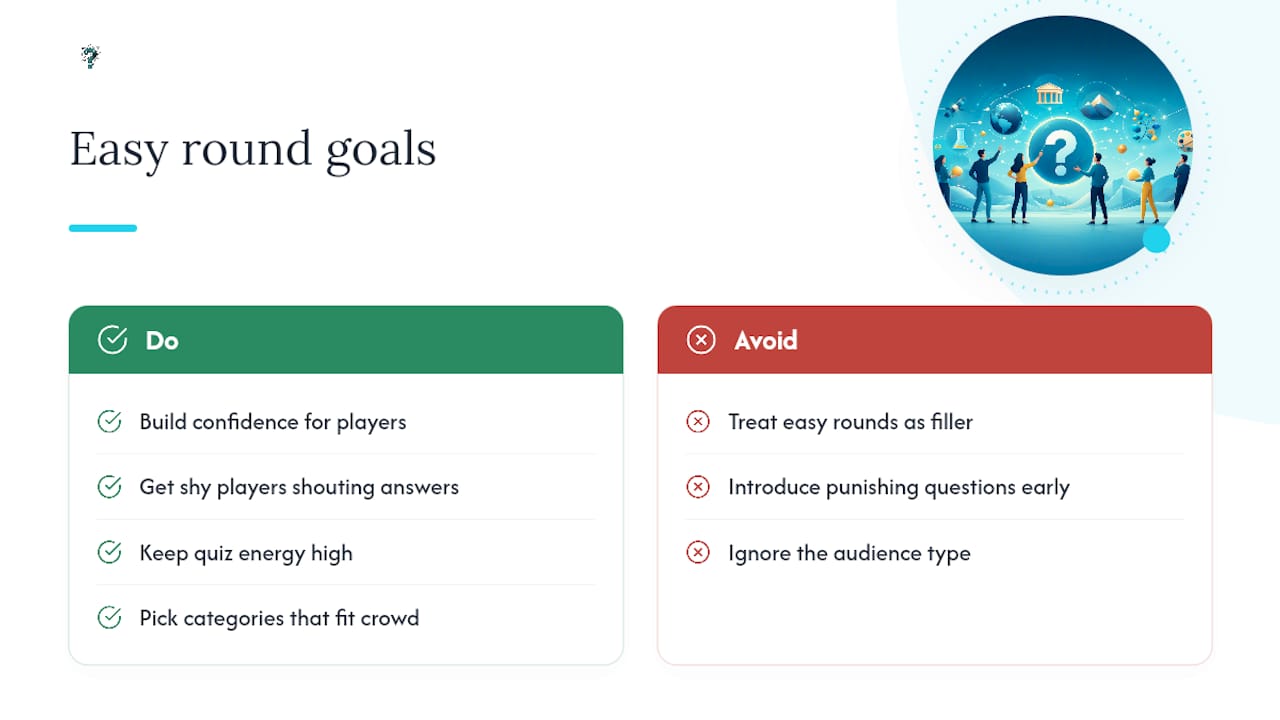
Easy rounds do real work in a quiz. They build confidence, get shy players shouting out answers, and keep the energy up before you introduce anything punishing. Think of this bucket as your on ramp, not filler. Below is a large, browsable set organized by category so you can grab exactly what fits your crowd, whether that’s a family game night or a casual bar crowd that just wants to feel smart for an hour.
Geography basics
- What is the smallest country in the world? Answer: Vatican City
- Which continent is the Sahara Desert located on? Answer: Africa
- What is the capital of Canada? Answer: Ottawa
- Which U.S. state is known as the Sunshine State? Answer: Florida
- What is the largest country by land area? Answer: Russia
- Which river runs through Egypt? Answer: The Nile
- What is the capital of Italy? Answer: Rome
- Which mountain range separates Europe and Asia? Answer: The Ural Mountains
- What is the capital of Spain? Answer: Madrid
- Which country is shaped like a boot? Answer: Italy
- What ocean lies between the Americas and Europe? Answer: The Atlantic Ocean
- What is the capital of Germany? Answer: Berlin
Pop culture and entertainment
- What is the name of the wizarding school in the Harry Potter series? Answer: Hogwarts
- Who directed the movie Jaws? Answer: Steven Spielberg
- Which band released the album Abbey Road? Answer: The Beatles
- What is the highest-grossing animated movie of all time (as of its release), featuring a frozen kingdom? Answer: Frozen II
- Who played Iron Man in the Marvel Cinematic Universe? Answer: Robert Downey Jr.
- What TV show features a group of friends living in New York and hanging out at Central Perk? Answer: Friends
- Which streaming platform produced Stranger Things? Answer: Netflix
- Who is known as the “King of Pop”? Answer: Michael Jackson
Everyday science
- What is the boiling point of water at sea level in Fahrenheit? Answer: 212°F
- How many bones are in the adult human body? Answer: 206
- What force pulls objects toward the Earth? Answer: Gravity
- What is the chemical formula for water? Answer: H2O
- Which planet is closest to the sun? Answer: Mercury
- What part of the plant conducts photosynthesis? Answer: The leaves
- What is the freezing point of water in Celsius? Answer: 0°C
- What gas makes up most of Earth’s atmosphere? Answer: Nitrogen
Common facts and history
- Who was the first president of the United States? Answer: George Washington
- What year did the Titanic sink? Answer: 1912
- Which country hosted the first modern Olympic Games? Answer: Greece
- What is the name of the ship that brought the Pilgrims to America? Answer: The Mayflower
- Who invented the telephone? Answer: Alexander Graham Bell
- What wall divided East and West Berlin during the Cold War? Answer: The Berlin Wall
- What was the first country to grant women the right to vote? Answer: New Zealand
- What ancient wonder still stands today? Answer: The Great Pyramid of Giza
Food and everyday life
- What fruit is traditionally associated with Sir Isaac Newton’s discovery of gravity? Answer: An apple
- What is the main ingredient in guacamole? Answer: Avocado
- What type of pastry is used to make a croissant? Answer: Puff pastry (laminated dough)
- Which country is famous for inventing pizza? Answer: Italy
- What drink is made by fermenting grapes? Answer: Wine
- What is the most consumed beverage in the world after water? Answer: Tea
Use easy questions as your opening round and again as a “confidence round” midway through if scores are getting lopsided. It resets the mood without feeling like a mercy round.
Medium General Knowledge Questions and Answers for the Main Rounds
Medium questions are the backbone of any real quiz night. They’re hard enough to separate the casual players from the trivia regulars, but they won’t make half the room groan and check their phones instead of guessing. This is where most of your point total should live. A common structure: worth two points each, versus one point for easy and three (or more) for hard.
- What is the second largest planet in our solar system? Answer: Saturn
- Who wrote 1984? Answer: George Orwell
- What year did the French Revolution begin? Answer: 1789
- Which element has the atomic number 1? Answer: Hydrogen
- What is the capital of Brazil? Answer: Brasília
- Who composed The Four Seasons? Answer: Antonio Vivaldi
- Which country is home to the Great Barrier Reef? Answer: Australia
- What is the term for a word that reads the same forward and backward? Answer: Palindrome
- Who was the first man to walk on the moon? Answer: Neil Armstrong
- What is the longest bone in the human body? Answer: The femur
- Which artist cut off part of his own ear? Answer: Vincent van Gogh
- What is the capital of South Korea? Answer: Seoul
- Which vitamin is produced when skin is exposed to sunlight? Answer: Vitamin D
- What is the main language spoken in Brazil? Answer: Portuguese
- Which war was fought between the North and South regions of the United States? Answer: The Civil War
- What is the term for a group of lions called? Answer: A pride
- Which country invented paper? Answer: China
- What is the smallest bone in the human body? Answer: The stapes (in the ear)
- Who wrote Pride and Prejudice? Answer: Jane Austen
- What is the largest desert in the world? Answer: The Antarctic Desert (many assume the Sahara, but Antarctica qualifies as a desert by precipitation)
- What year did the Titanic set sail on its maiden voyage? Answer: 1912
- What is the capital of Egypt? Answer: Cairo
- Which instrument has 88 keys? Answer: The piano
- What planet has the most moons confirmed as of recent counts? Answer: Saturn
- Who painted The Starry Night? Answer: Vincent van Gogh
- What is the study of earthquakes called? Answer: Seismology
- Which country is the largest exporter of coffee? Answer: Brazil
- What is the tallest waterfall in the world? Answer: Angel Falls, Venezuela
- Who is the Greek goddess of wisdom? Answer: Athena
- What is the capital of Argentina? Answer: Buenos Aires
- What blood type is considered the universal donor? Answer: O negative, according to the American Red Cross
- What year did the Berlin Wall come down? Answer: 1989
- What is the currency used in the United Kingdom? Answer: The pound sterling
- Which planet is famous for its rings? Answer: Saturn
- Who directed Pulp Fiction? Answer: Quentin Tarantino
- What is the name of the first artificial satellite launched into space? Answer: Sputnik 1
- Which country is the birthplace of democracy? Answer: Greece
- What is the medical term for high blood pressure? Answer: Hypertension
When you’re assembling your main rounds, alternate between categories so the same three trivia buffs at table four don’t dominate every single question.
Hard General Knowledge Questions and Answers for Final Rounds
Hard rounds separate the trivia regulars from everyone else, and that’s exactly the point. Save these for your final round or a dedicated “expert” segment, and be ready to accept close variants on names, dates, and spellings. A surprising number of hosting disputes come down to one player insisting their answer was “close enough,” so decide your rule on partial credit before the round starts, not during it.
- What is the only mammal capable of true flight? Answer: The bat
- Which shark species is most frequently implicated in unprovoked attacks on humans, according to tracked incident data? Answer: The great white shark, per the Florida Museum’s shark attack data
- What ancient civilization built Machu Picchu? Answer: The Inca
- Which element has the highest melting point of any metal? Answer: Tungsten
- What was the name of the first computer virus? Answer: Creeper
- Which country was formerly known as Persia? Answer: Iran
- Who was the shortest serving U.S. president? Answer: William Henry Harrison (31 days)
- What is the rarest blood type? Answer: AB negative
- What bird can distinguish between individual human faces and remember them for years, according to behavioral research? Answer: The crow, a finding documented in Science
- Which country has the most pyramids in the world? Answer: Sudan, not Egypt
- What is the only letter not appearing in any U.S. state name? Answer: Q
- Which planet rotates on its side, nearly perpendicular to its orbit? Answer: Uranus
- What is the term for fear of long words? Answer: Hippopotomonstrosesquippedaliophobia
- Which country consumes the most tea per capita? Answer: Turkey
- What is the only food that never spoils? Answer: Honey
- Who was the youngest person to win a Nobel Prize? Answer: Malala Yousafzai (age 17)
- What is the term for a baby kangaroo? Answer: A joey
- Which organ can regenerate itself even after up to 70% is removed? Answer: The liver
- What natural material forms inside oysters and other mollusks as a defense mechanism, prized for jewelry? Answer: A pearl, a process explained by The Met Store’s blog on pearl formation
- What was the shortest war in recorded history? Answer: The Anglo-Zanzibar War of 1896, lasting roughly 38 minutes
A note on scoring hard questions: consider awarding partial credit when a team names the right general answer but misses a fine detail (a close year, a near-correct spelling). It keeps morale up without gutting the challenge.
Trivia hosts often notice hard rounds generate the most disputes of any segment in a session, simply because obscure facts have more room for “well actually” moments. Building in a short verification pause, rather than an on-the-spot ruling, saves you from arguments you can’t win gracefully.
Themed Category Packs: Ready Rounds by Topic
Themed rounds turn a generic quiz into an event people talk about afterward, and matching your theme to your crowd matters more than most hosts assume. A pack built around 90s pop culture flops at a retirement community mixer just as badly as a classical art round flops at a college bar. Each pack below runs 8 to 12 questions, worth 1 to 3 points depending on difficulty, and pairs with a quick hosting tip to boost engagement.
- Pop culture: Questions on movies, music, and celebrity trivia (e.g., “Which artist released Thriller?” Answer: Michael Jackson). Pro Tip: Play a five-second audio clip and award bonus points for naming the song before the round even starts. Best for younger or mixed-age social crowds.
- History: Covers major wars, revolutions, and historical figures (e.g., “Who was the first female pharaoh of Egypt?” Answer: Hatshepsut). Pro Tip: Show a black-and-white photo and ask players to identify the era before revealing the actual question. Works well for adult and multigenerational groups.
- Science: Ranges from basic biology to space facts (e.g., “What is the powerhouse of the cell?” Answer: The mitochondria). Pro Tip: Bring a prop, even something as simple as a periodic table printout, to make the round feel hands-on. Great for classroom settings or STEM-minded groups.
- Geography: Capitals, landmarks, and physical geography (e.g., “What is the smallest country in South America?” Answer: Suriname). Pro Tip: Use a blank map slide and have players point instead of just naming the answer. Works for travel clubs or international meetups.
- Sports: Records, athletes, and major tournaments (e.g., “Which country has won the most FIFA World Cups?” Answer: Brazil). Pro Tip: Play a crowd-noise sound clip from a famous match and ask players to guess the event. Ideal for bar nights and fan gatherings.
- Arts and literature: Painters, authors, and classic works (e.g., “Who wrote Moby Dick?” Answer: Herman Melville). Pro Tip: Show a cropped image of a famous painting and reveal more of it as a hint if nobody guesses right away. Fits book clubs and gallery events well.
Themed formats also tend to draw repeat attendance at recurring events, according to hosting guides on structuring themed trivia nights, since regulars start showing up specifically for “movie night” or “history night” rather than a generic weekly quiz. If you want a fully built themed set instead of assembling your own, Trivialism’s daily themed quiz archive publishes a new one every day with its own leaderboard.
How to Host and Run These Questions: Formats, Timing, and Scoring
You don’t need a professional setup to run a tight quiz night. You need a plan, a timer, and a clear scoring rule everyone agrees to before round one starts. Most successful trivia nights run 4 to 6 rounds of 8 to 10 questions each, which keeps the whole event around two hours without losing momentum, according to host-tested trivia night structures.
- Round 1, warmup (easy): 8 to 10 questions, one point each, 20 seconds per question.
- Round 2, main mix (medium): 10 questions, two points each, 30 seconds per question.
- Round 3, themed pack: 8 to 12 questions from one of your packs above, two to three points each.
- Round 4, hard finale: 8 questions, three points each, plus a tiebreaker question worth zero points but used only to break a tie.
- Break between rounds 2 and 3: five minutes, long enough for a bathroom run without losing the room’s energy.
For scoring, keep it simple: assign point values by difficulty (1 for easy, 2 for medium, 3 for hard), and reserve one closest-guess numeric question as your official tiebreaker (“What year was the Eiffel Tower completed?” works well). Avoid negative scoring. It punishes guessing, which is half the fun of trivia.
Running things virtually adds a few extra decisions. A 40-question virtual pub quiz guide recommends muting mics during answer time and using a chat command or private message for submissions to stop shouted answers from spoiling it for everyone else. If your group already lives on Discord, running the session through a Discord trivia bot solves the submission and scoring headache automatically instead of you tallying scrawled answers on a notepad.
| Element | Recommended setup |
|---|---|
| Total rounds | 4 to 6 |
| Questions per round | 8 to 10 |
| Total runtime | 90 to 120 minutes |
| Point spread | 1 (easy), 2 (medium), 3 (hard) |
| Tiebreaker | One closest-guess numeric question |
Author Perspective: How Trivialism Keeps Questions Accurate
We built Trivialism’s question bank the slow way: over 40,000 human-written questions across roughly 90 topics, not scraped or bulk-generated. Every flagged question routes through an AI-backed fact-checking pipeline before it goes back into rotation, which catches the outdated stats and contested “facts” that plague recycled trivia lists. If you ever spot a shaky answer in your own quiz, in-game flagging is the fastest fix, and localizing a question for your specific crowd (swapping a US-centric reference for one your group actually knows) almost always beats deleting it outright.
— Christian
Play These Questions Live on Trivialism
Trivialism is the alternative to building a spreadsheet quiz by hand: you get the exact category, difficulty, and round structure covered in this article, already loaded and ready to play, with zero setup time. Pick your categories and difficulty, share a room code, and your group can be answering questions in under a minute, whether you’re all in one room or scattered across a Discord voice channel.
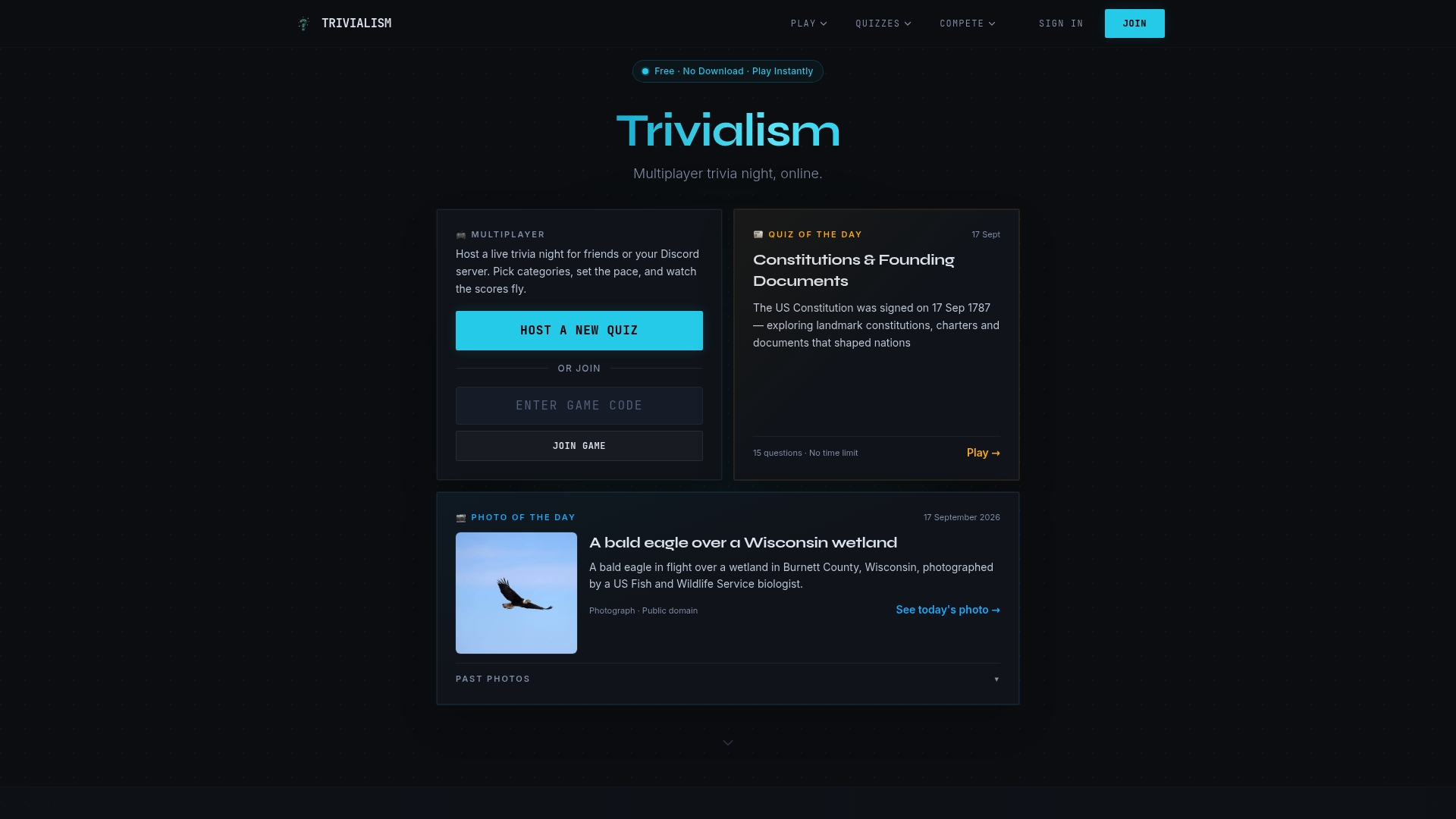
The platform offers multiple modes so you can match the pacing to your crowd, whether that’s a relaxed family round or a fast-paced tiebreaker among trivia regulars. Guests can join without creating an account, making it easy for players to participate without prior setup. The Daily Games page publishes a themed Quiz of the Day, so if building your own themed pack from the section above sounds like more prep than you want tonight, a ready-made one is already waiting. Head to Trivialism to start a room, or drop the bot into your Discord server and run your next quiz night exactly where your group already hangs out.
Sources
- Trivia Night Ideas: 50+ Themes, Formats & Round Ideas — TriviaHostHelp
- Pearls of wisdom: five things you may not know about pearls — The Met Store blog
- Science
- Species implicated in shark attacks — Florida Museum
FAQ
How many questions should a general knowledge trivia night have?
Most trivia nights run 4 to 6 rounds of 8 to 10 questions each, totaling 32 to 60 questions, which keeps the event to roughly 90 to 120 minutes. Add a short break between rounds 2 and 3 if you’re running the longer end of that range.
What’s a good mix of easy, medium, and hard questions?
A roughly 40/40/20 split (easy, medium, hard) keeps casual players engaged while still rewarding your sharpest guessers. Save the hardest questions for a final round or dedicated tiebreaker instead of scattering them throughout.
How do I run trivia questions virtually without chaos?
Mute microphones during answer time and collect submissions through chat or a private message system to stop shouted answers from spoiling it for others, a method detailed in EF’s virtual pub quiz guide. Running the session through a platform like Trivialism, either in-browser or via its Discord bot, handles scoring and submissions automatically.
Can I use these questions for kids or family game night?
Yes. Stick mostly to the easy set, pull two or three medium questions for older kids or teens, and skip the hard round entirely unless your family includes serious trivia fans. Adjust proper nouns and cultural references to what your specific age group would actually recognize.
What should I do if a team disputes an answer?
Decide your partial-credit rule before the quiz starts, not in the middle of a dispute, and keep one source (like the ones listed above) on hand to settle contested facts quickly. If a question is genuinely ambiguous, award the point rather than losing five minutes of momentum arguing about it.